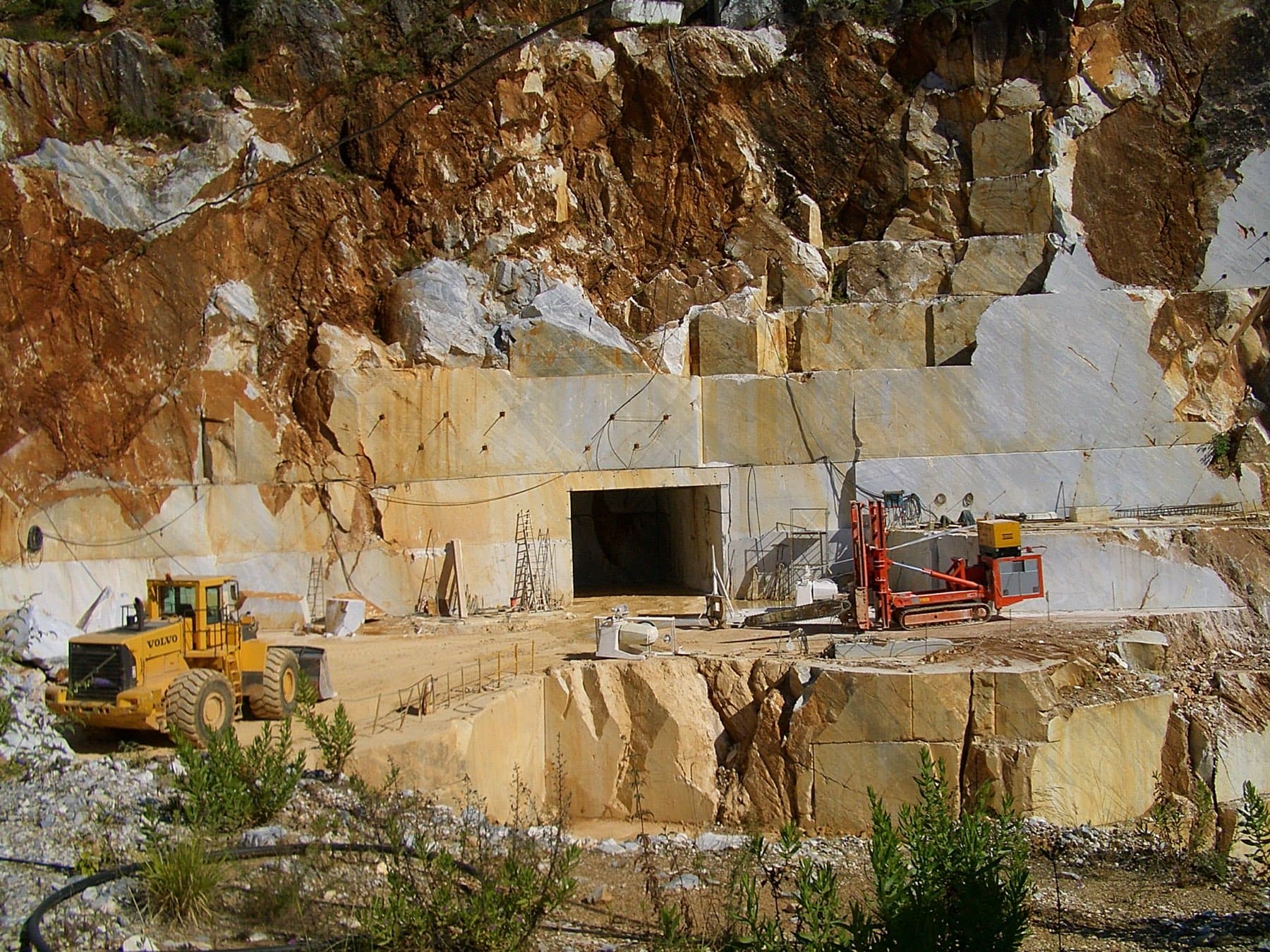
A tonne of marble leaving Pakistan in 2024 was worth, on average, 181 US dollars.
That single number explains more about the country's stone sector than any reserve estimate, and it points at a problem that is not really about geology at all. The rock is not the constraint. What happens to the rock between the face and the buyer is the constraint.
The comparison, stated honestly
The obvious next question is what everyone else gets. The honest answer requires a caveat that most commentary on this subject leaves out.
The comparable per tonne figures we can source for Italy and Turkey are 315.62 dollars and 185.52 dollars, and they are from 2017, not 2024. Comparing a 2024 Pakistani average against 2017 European averages is not a clean like for like, and anyone presenting it as one is overselling. Prices moved in the intervening years.
What survives the caveat is the shape of the gap rather than its precise width. Italian stone has been leaving at roughly one and a half to two times the Pakistani figure for a long time, and the reason is not that Italian marble is a better rock. Carrara is a superb stone, but so is a good white from Mohmand. The difference is what condition the material is in when it crosses the border, and who has done the work of putting it in that condition.
Where the value is actually captured
Follow a block from a Pakistani quarry and the pattern becomes obvious.
In 2024, China took around 72 per cent of Pakistan's marble exports by value. Italy took about 9 per cent. Material moves to processing centres, principally in China, where it is cut, calibrated, polished, graded, packed and in many cases branded. It then enters the market as finished slab, often at a destination far from the country whose flag flew over the quarry.
Every operation in that sentence is a margin. Sawing is a margin. Resin treatment and reinforcement is a margin. Calibration to a tolerance a fabricator will accept is a margin. Grading, which is the act of separating one lot into three price bands instead of selling all of it at the lowest, is the largest margin of all and requires no machinery beyond a trained eye and a lit shed.
None of those margins currently accrue in Pakistan at meaningful scale. They accrue in Xiamen.
This is not a uniquely Pakistani condition, and framing it as a national failing misreads it. It is the standard position of a raw block exporter anywhere in the world. India ships enormous tonnage and faces a version of the same question. What distinguishes producers who have moved up the chain is rarely a policy announcement. It is usually the unglamorous accumulation of processing capacity, quality control and buyer relationships over a decade or more.
Tonnage and value point in opposite directions
There is a useful check on any claim about who dominates this trade. Rank the exporters by tonnage and you get a different list than if you rank them by value.
On 2021 tonnages, India exported 15.5 million tonnes, Turkey 7.76 million and China 6.6 million. Rank the same market by export value and China leads comfortably. A country can be simultaneously a large exporter of stone and a small earner from it, and the gap between those two positions is precisely the processing gap.
One caution on the value figures that circulate. The most widely cited export value table, presented in July 2026 to the Confindustria Marmomacchine general assembly, combines stone materials with stone processing machinery. Italy is a major exporter of the machines other countries use to cut stone, so its position in that table is inflated relative to a pure materials comparison. We flag this because the table is quoted constantly without the caveat, including by people selling advice.
The waste that happens before any of this
Upstream of the processing question sits a cruder loss, and it is the one an owner can act on fastest.
The Pakistan Stone Development Company puts wastage under conventional blasting at around 85 per cent, falling to roughly 45 per cent where quarrying has been mechanised. Those are PASDEC's own figures and should be read as such rather than as an independent audit. Even taken at face value, the second number is not good. A 45 per cent loss would be considered poor in most established dimension stone districts.
The scale of adoption tells its own story. PASDEC reports 135 mines nationally having moved to mechanised methods, against combined public and private investment of about 1.16 billion rupees. Against the size of the sector, 135 is a small number. The transition has started. It has not happened.
Blasting a dimension stone deposit is the most expensive decision in the whole chain, because it destroys value that no amount of downstream processing can recover. A fractured block cannot be un-fractured. Every margin discussed above is applied to whatever volume survives extraction, which means recovery rate multiplies through the entire economics rather than adding to it.
The processing zones, honestly assessed
Pakistan's answer to the value capture problem has largely been industrial estates. Five marble cities have been inaugurated: Gadani, Mohmand, Risalpur, Chitral and Loralai.
Risalpur is the one that has gone furthest. It covers 185 acres with 218 plots. Fifty six plots have been handed over, 20 units are under construction, and 15 are in production. Those are PASDEC's own published figures for the estate. Gadani, by contrast, has been reported as largely on paper, though we have not found a published account that itemises what it lacks, so we put it no more strongly than that.
Fifteen operating units in the most advanced zone is a real achievement measured against zero, and a modest one measured against the ambition. Fifteen in production against 218 plots is the number to hold. A zone is counted as delivered when the land is allotted, and it earns nothing until a gangsaw is turning on it, which is a gap that reporting on these estates rarely closes. Processing stone is an electricity business before it is anything else, and power at the plot, rather than acreage on a plan, is the input worth asking about before anyone commits capital to a zone.
What we would tell an owner
If you hold a lease and you are trying to decide where to spend, the order is not intuitive.
Recovery comes first, because it multiplies everything downstream and because it is the cheapest intervention per dollar of value recovered. Grading comes second, because separating your output into price bands costs almost nothing and is the fastest available uplift on the same tonnage. Processing capacity comes third, and only where power is genuinely secured rather than promised.
The 181 dollar tonne is not evidence of a poor deposit. It is evidence of material leaving in the condition it came out of the ground. That is a fixable problem, and fixing it does not begin with a new machine or a new zone. It begins with not breaking the block.