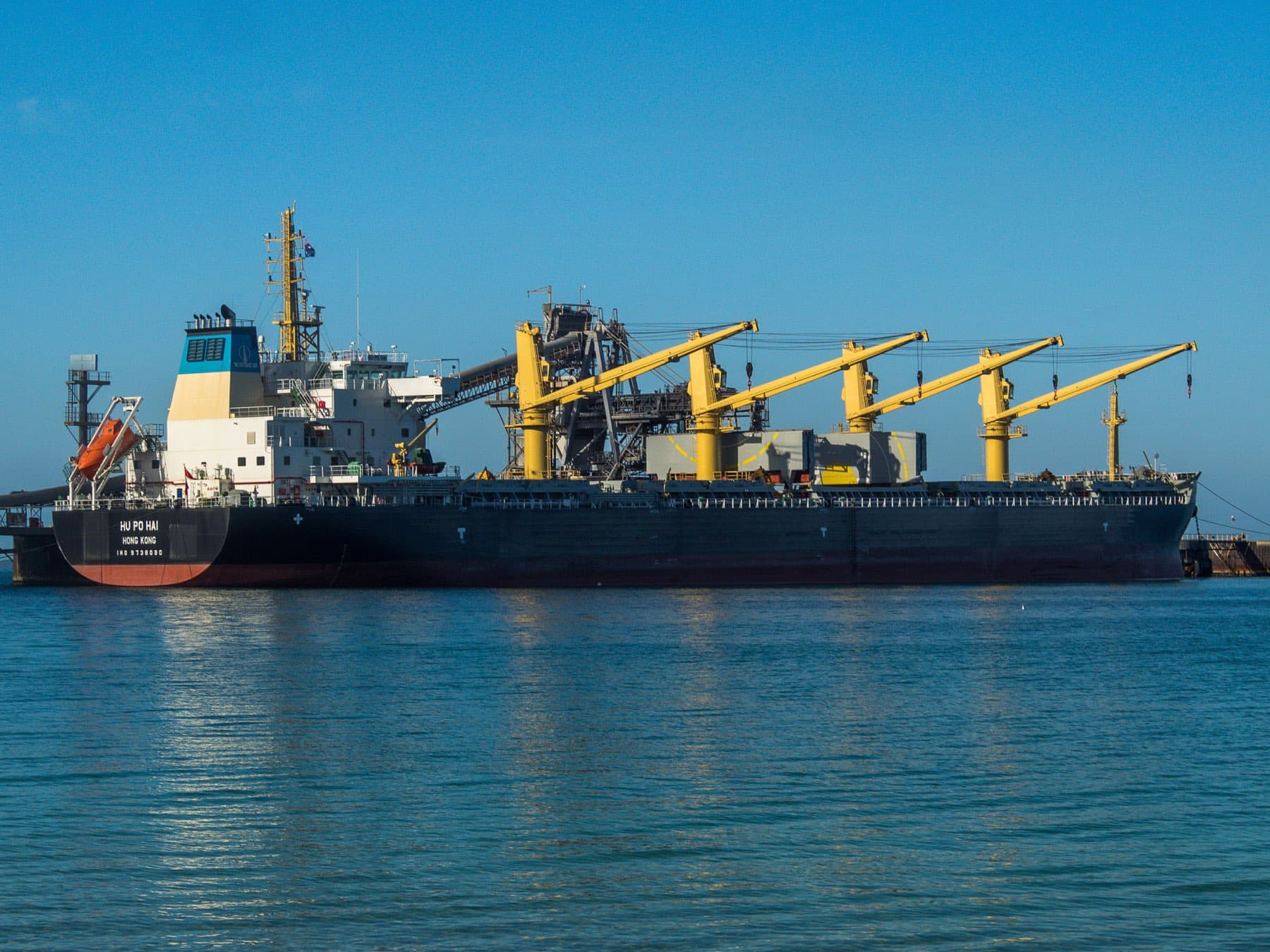
Ask most people in the minerals trade what shipping will cost to decarbonise and you will get a confident answer. A price per tonne of carbon, a compliance date, a line in next year's freight budget. The confidence is misplaced. As of today, no ship anywhere in the world pays a global carbon charge, and the mechanism that was supposed to impose one is still being renegotiated.
Understanding exactly where that process stopped, and why, is worth more to an exporter than any forecast of where it might end up.
What was agreed, and what was not
In April 2025, at its 83rd session, the Marine Environment Protection Committee of the International Maritime Organization approved in principle a Net-Zero Framework for international shipping. It would have applied to vessels above 5,000 gross tonnes, which covers essentially every ship that moves a commercial parcel of stone, ore or concentrate. The mechanism was built around a greenhouse gas fuel intensity measure, benchmarked against a 2008 industry average of 93.3 grams of CO2 equivalent per megajoule, with fuels at or below 19.0 grams classed as zero or near zero.
Approval in principle is not adoption. Adoption required a further vote, and that vote never happened.
At an extraordinary session held from 14 to 17 October 2025, member states voted 57 to 49 to adjourn the decision for twelve months rather than adopt the framework. The Committee returned to the subject at its 84th session, which ran from 27 April to 1 May 2026, and agreed only to continue work on a revised framework. It did set a date to decide: the adjourned extraordinary session is due to resume on 4 December 2026, immediately after MEPC 85, to take a further decision on adoption. Intersessional meetings were scheduled for September and November 2026. A date to decide is not a decision, and the October 2025 vote is the reason to treat the December date as a hearing rather than an outcome.
So the position today is precise and easily stated. There is a draft. There is no adopted instrument, no entry into force, and no price.
Why the draft numbers should not be budgeted
The figures that circulate most widely come from the version approved in principle in April 2025: a two tier remedial unit price of 100 US dollars and 380 US dollars per tonne of CO2 equivalent. Those numbers are real, in the sense that they appeared in a real draft. They are also the parameters most likely to move, because they are the parameters states disagreed about.
We have seen operators build them into landed cost models as though they were law. That is a mistake in both directions. It overstates near term cost, and it understates the risk that the eventual instrument is structured differently enough that a model built on the 2025 draft has to be discarded rather than adjusted.
There is a further problem. We have not been able to find a credible published estimate of what the framework would cost per tonne of dry bulk mineral cargo. Freight is priced per day of vessel time, not per tonne of carbon, and the pass through depends on vessel age, fuel choice, route and the charter market at the time. Anyone quoting you a confident per tonne figure for a granite parcel out of Karachi is extrapolating, not citing.
Regulation is still advancing, just not where everyone is looking
The temptation, having read the above, is to conclude that maritime environmental regulation has stalled. It has not. It has become less uniform, which is harder to plan for.
At the same session where the Net-Zero Framework went unresolved, the Committee adopted a new Emission Control Area for the North-East Atlantic, entering into force on 1 September 2027, with the emission limits themselves applying twelve months after that. Read the two dates separately before putting either into a fuel budget. Emission Control Areas are geographic. They bite on the route rather than on the fleet, and they arrive on schedule whether or not the global instrument does.
This is the pattern worth planning around. A single global price applied evenly to all competitors is, from a trading point of view, close to neutral. It raises everybody's cost and passes through into freight. Regional and route specific measures are not neutral at all. They advantage the seller whose cargo takes one path to market and penalise the seller whose cargo takes another, and they do it without any announcement that reads like a carbon price.
What this means for a seller in South Asia or the Gulf
Three practical positions follow.
First, do not sign multi-year offtake at fixed landed prices on the assumption that a known carbon cost is coming. The cost is not known. If a buyer proposes a fixed landed price with an environmental adjustment clause referencing the IMO framework, that clause is currently referencing something that does not exist. It needs to be drafted around a defined event, not a presumed one.
Second, treat fuel and route exposure as the live variable, because it already is. The vessels that carry mineral parcels are older and less efficient on average than the container fleet. When a framework is eventually adopted, older tonnage will be repriced first, and the charter market will reflect that well before any compliance date.
Third, get your cargo's emissions documented now regardless. Buyers in Europe are already asking suppliers for embedded emissions data for reasons that have nothing to do with the IMO, and a seller who can answer that question in a week rather than a quarter is in a materially stronger negotiating position. The work required is the same work the framework would eventually demand. Doing it early converts a future compliance cost into a present commercial advantage.
The discipline this asks for
There is a wider point here about how a trading business consumes regulatory news.
The Net-Zero Framework was reported as adopted by a great many outlets in April 2025, because approval in principle reads like adoption if you are not watching the procedure. Anyone who built a plan on those reports has spent more than a year planning around an instrument that does not exist, and would have had no signal that anything was wrong, because the correction was never as widely reported as the original.
The minerals trade is unusually exposed to this. Our counterparties are spread across jurisdictions, the regulation that affects us is made in bodies most sellers never observe directly, and the intermediaries who summarise it for us are usually selling something. The defence is not to read more commentary. It is to check, on the small number of decisions that actually move money, what the issuing body itself has published, and on what date.
That is unglamorous work. It is also the difference between a landed cost model that survives contact with a real shipment and one that does not.