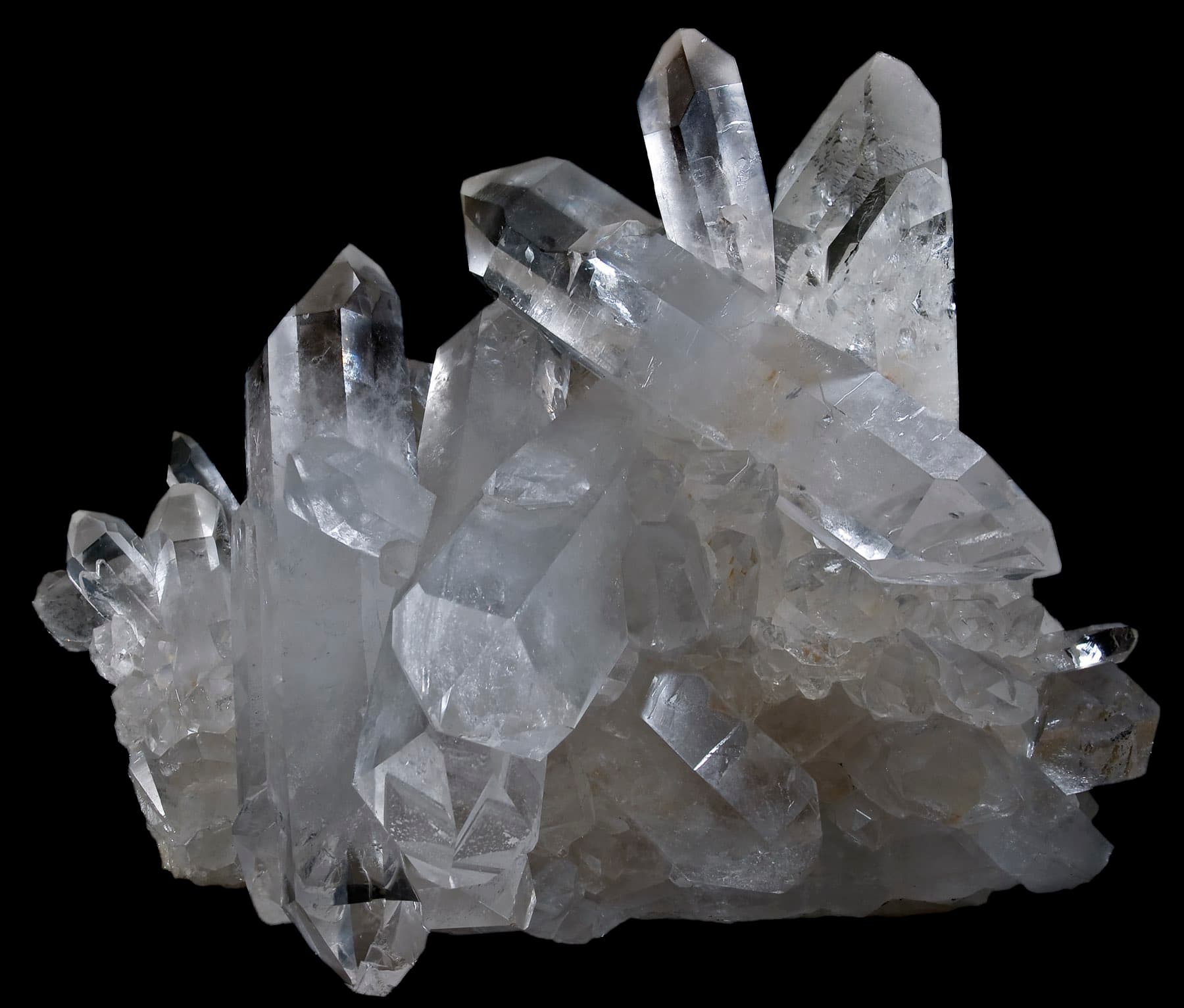
The word quartz covers two commodities that have almost nothing to do with one another. One is a common rock, abundant on every continent, sold by the tonne and used in glass, foundry sand, construction and countertop composites. The other is a refined material sold by the kilogramme into semiconductor and solar manufacturing, produced in commercial volume in essentially two places on earth, and separated from the first by several orders of magnitude in both purity and price.
Conflating them is the most expensive mistake we see sellers make when they enter this market. It is easy to make, because the assay says quartz in both cases, and because a great deal of material is marketed as high purity by people who have never seen the specification the term actually refers to.
Where the material actually comes from
Spruce Pine in North Carolina and Kyshtym in Russia together account for roughly 95 per cent of global high purity quartz, on figures from Mordor Intelligence. A narrower claim in circulation, that Spruce Pine alone accounts for between 70 and 90 per cent of semiconductor grade material specifically, we have not been able to trace to a named source and do not rely on. The width of that range is itself informative: this is a market small enough, and closely enough held, that even the people who study it professionally are working from estimates.
What is not in doubt is the shape. A single valley in one American state is the origin of the crucibles in which nearly all of the world's silicon is melted. There is no comparable concentration anywhere else in industrial minerals, and it exists for a geological reason rather than a commercial one. Spruce Pine pegmatite is unusually free of the trace elements, particularly aluminium, that cannot be economically removed downstream and that ruin the material for its end use.
That last point is the one worth understanding properly. High purity quartz is not made by processing ordinary quartz harder. Beneficiation removes what can be removed. The impurities that matter most in this application are locked inside the crystal lattice, substituting for silicon atoms, and no amount of grinding, flotation, acid leaching or calcination gets them out. The deposit either has them or it does not, and that is decided at formation.
What September 2024 demonstrated
In September 2024, Hurricane Helene halted operations at Spruce Pine for both Sibelco and The Quartz Corp.
The interesting thing about that event is not the stoppage itself but that it was the first time many people downstream discovered the dependency existed. A weather system in Appalachia stopped the flow of a material required to make semiconductors, and the chain of causation was invisible to almost everyone in it, because the quartz is three or four transformations upstream of anything a chip buyer negotiates over.
Concentration risk in minerals is usually discussed in terms of geopolitics. Spruce Pine is a reminder that it does not require an adversary. A hurricane, a fire or a permitting dispute in one county produces the same outcome, and none of those can be diversified away by a buyer who has no second source to move to.
Sibelco has been investing. The company reports a programme of roughly 200 million dollars across 2023 to 2025, intended to double installed high purity quartz capacity against the 2022 base, following an earlier increase of about 30 per cent achieved through process efficiencies between 2019 and 2022, together with a study covering a further sum of roughly 500 million dollars across 2024 to 2027. That is a serious commitment and it materially increases available volume. It does not change the geography. Additional capacity at Spruce Pine is more of the same bottleneck, not a second one.
The substitution that does not work
The obvious question is why the material is not simply synthesised. It can be. The economics are the obstacle.
Synthetic quartz runs at five to ten times the cost of natural, according to Construction Physics, and at a consumption of 25 to 30 tonnes of quartz per gigawatt of wafer production, that multiple is fatal for solar. Semiconductors can absorb it, because the quartz cost is trivial against the value of a finished wafer. Solar cannot, because the whole industry is a cost per watt competition and has been for two decades.
This matters for how anyone should read forecasts of substitution. The bottleneck is not technical. Nobody needs to invent anything. The bottleneck is that the application which consumes the most tonnage is the one least able to pay a premium, which is an unpromising basis for the capital investment that would relieve it.
What has not appeared
As of August 2026 we have found no evidence that any material alternative source of high purity quartz has come online.
We want to be careful about how that is stated. This is an absence of evidence, not proof of absence. Deposits are evaluated privately, qualification into a semiconductor supply chain takes years and is not announced, and a producer with a genuine alternative has commercial reasons to be quiet about it for as long as possible. Our search is not the market. What we can say is that nothing has been publicly established, and that a seller planning around an imminent new source is planning around something that has not been demonstrated.
The distinction a seller has to hold
Halberg's clients sell ordinary quartz. We want to be direct about that, because the temptation running through everything above is obvious.
An article describing a global shortage of high purity quartz reads, to someone holding a quartz lease, like a market opening. It is not, and the gap between the two materials is very much larger than most people entering this trade expect. Material commonly marketed as high purity, including material carrying laboratory certificates that look impressive, is routinely nowhere near Spruce Pine specification. The relevant impurities are measured in parts per million, the certificates that circulate frequently report on the wrong elements or at the wrong detection limits, and a deposit can be excellent by every ordinary standard and still be disqualified by a single element present at a concentration a general purpose laboratory would not think to report.
We say this plainly because the alternative is that a seller spends real money on drilling, sampling and travel pursuing a qualification he was never eligible for. That happens, and it happens more often when the market is being written about.
The useful position is the opposite one. Ordinary quartz has genuine markets in glass, foundry work, ferrosilicon and construction materials, and those markets are large, they buy consistently, and they are reachable from South Asia and the Gulf on freight economics that work. They are also markets where the winning attributes are consistency of grade, reliability of delivery, and sizing to a stated specification, all of which an operator controls and none of which depend on being lucky in your geology.
The seller who tests his material honestly, finds it is ordinary, and then builds a disciplined ordinary quartz business will earn more over ten years than the one who spends three of those years chasing a semiconductor qualification. The first step in either case is the same, and it is the step most frequently skipped: get a full trace element analysis, at semiconductor relevant detection limits, from a laboratory that does this work routinely, and find out which commodity you are actually holding before you decide which market you are in.