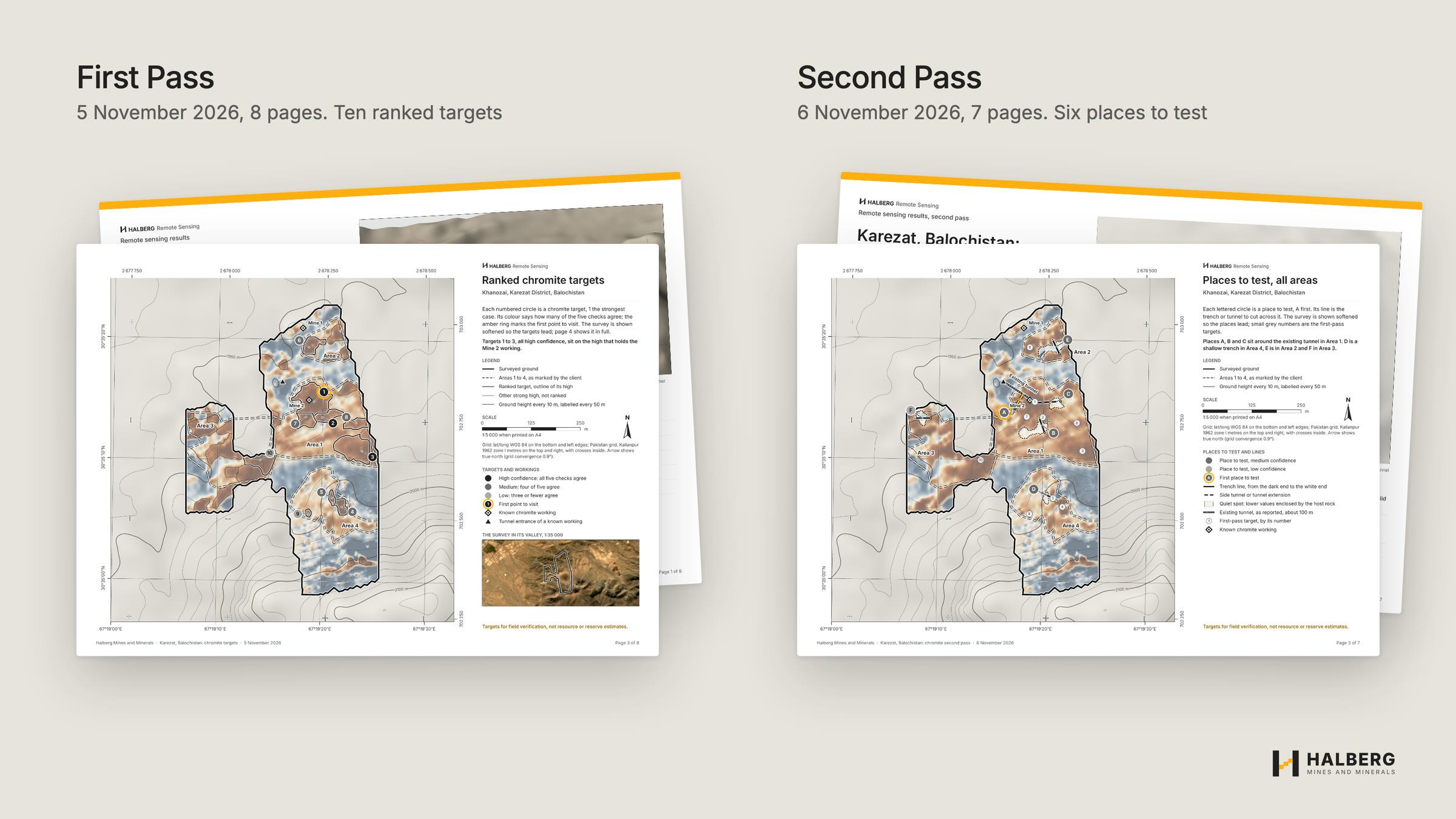
We recently delivered two chromite reports to Mir Mines & Minerals for their ground at Karezat, Balochistan, one day apart. The first ranked where the chromite is most likely to sit. The second used what the company's own tunnel had shown to set out exactly where to test next. Both reports are published here with the company's agreement, in one document with each pass clearly marked: First Pass and Second Pass, PDF.
This note explains what each pass contains, what changed between them, and why the order of work on a chromite lease matters as much as the map.
What Mir Mines & Minerals asked
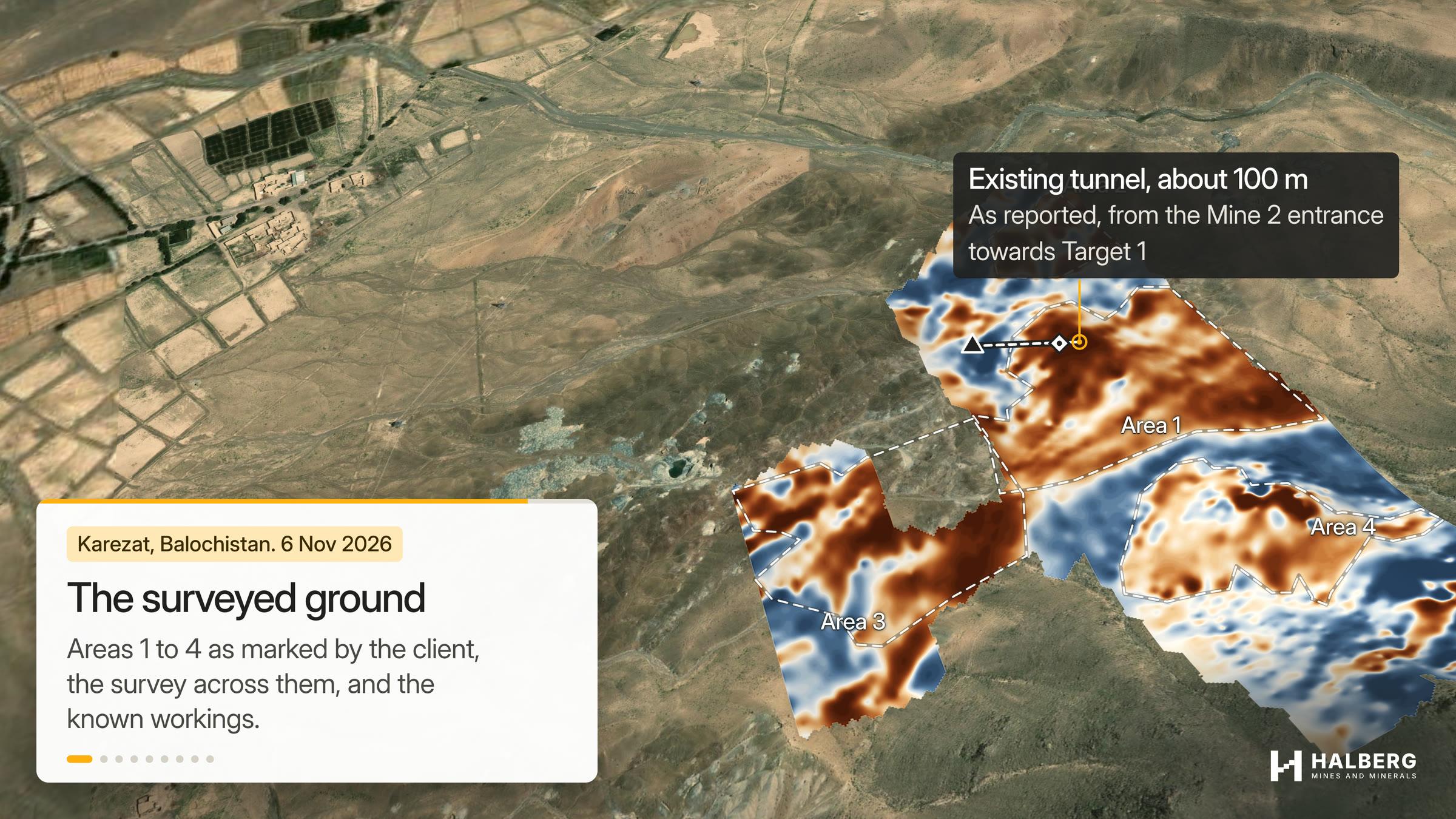
The company holds four areas at Karezat, about 10 hectares in all, inside a ground survey of about 20 hectares made by its contractor. Chromite workings already exist on the ground, including the company's own. The questions were the ones every lease holder asks: where is the chromite most likely to sit, where should digging start, and how deep is it.
The scope was chromite only, inside the four areas, using the company's own survey and the ground itself.
Pass 1: ten ranked targets, 5 November
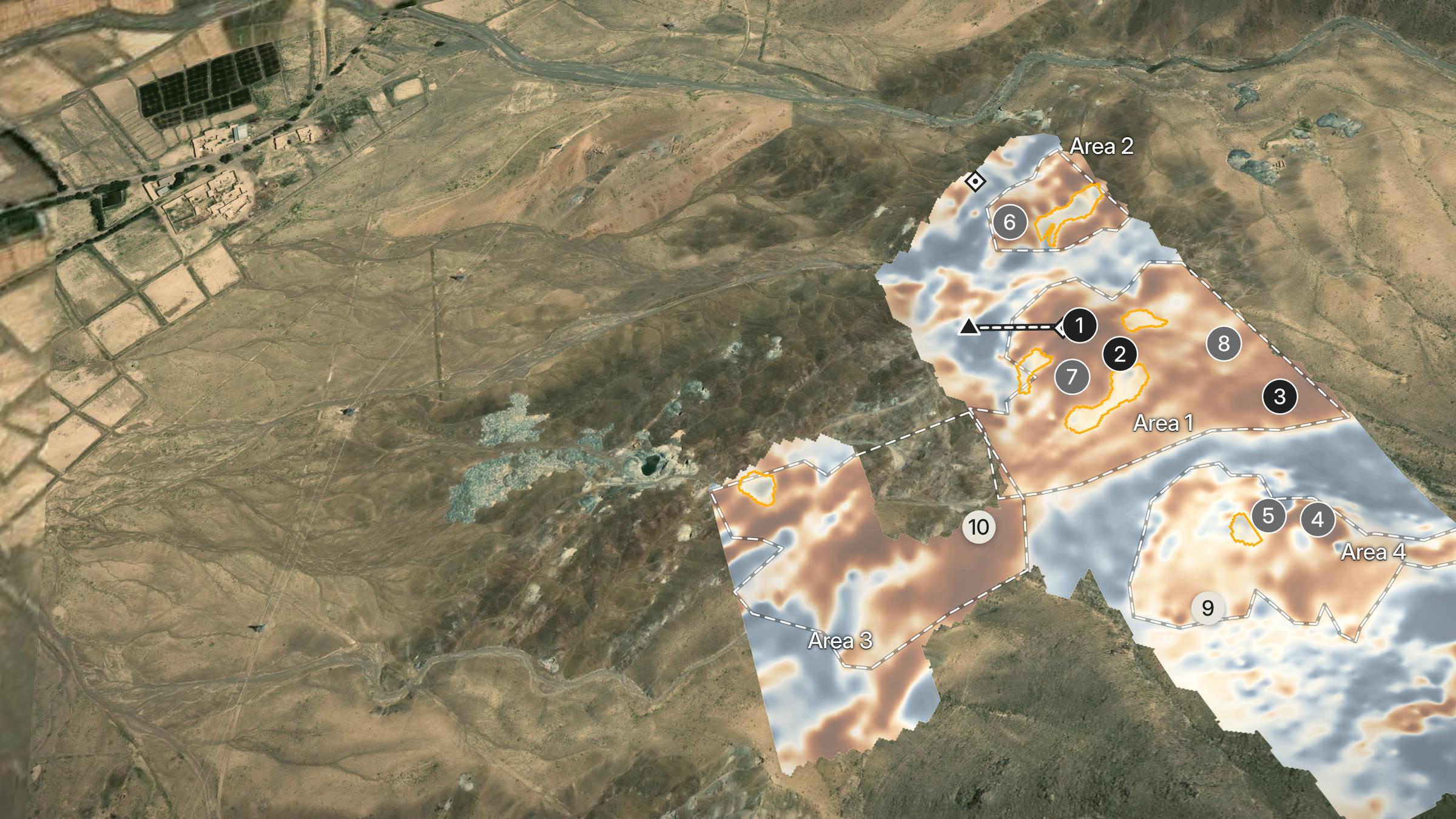
Our remote sensing team in Canada examined the 21 strongest readings inside the four areas and ranked the best 10 as chromite targets, first to last. Each target was checked five ways:
- the strength and shape of its reading in the survey
- whether it sits in the rock that carries chromite in this ground
- nearby faults and fractures
- how much rock is exposed at the surface
- its distance from the chromite workings already on site
A target where all five agree is rated high confidence. Three targets reached that level, five were medium and two were low.
The First Pass report runs to eight pages. It gives:
- a ranked map of all ten targets with a confidence for each, at 1:5,000 on A4
- the depth to the top of the chromite-bearing rock at every target, mostly within 20 metres of the surface
- why each target ranks where it does
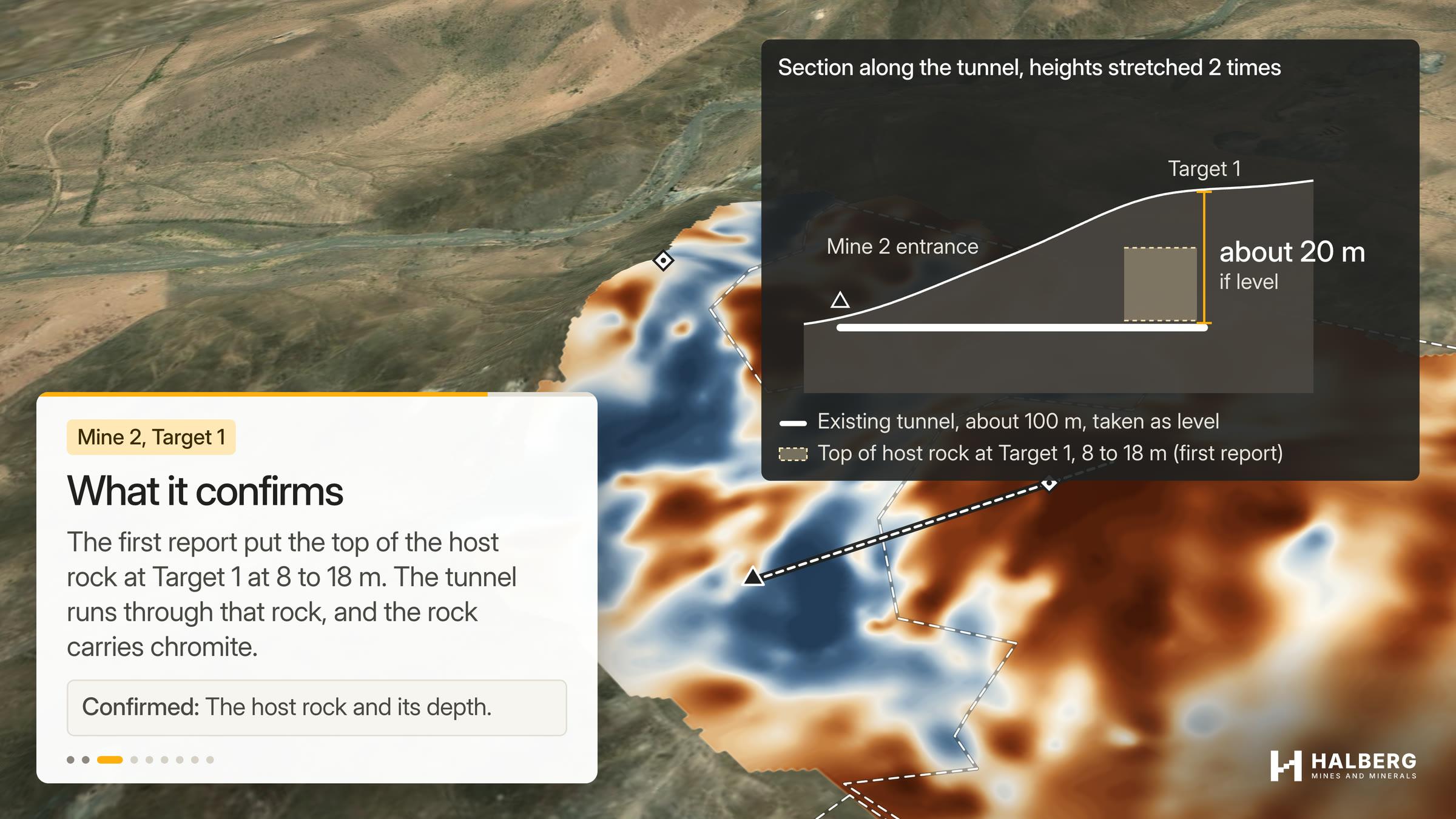
- the first point to visit, Target 1 in Area 1, beside the company's Mine 2 working, with the top of the host rock at 8 to 18 metres
- the second and third points to visit on the same high, and a walking route between them
- coordinates on the Pakistan grid the company's surveyors use, as well as latitude and longitude, with files that open on a phone in the field
The first version was built on the survey image the company sent. Later that day its contractor's full survey report arrived, with the real reading values and the positions of the known workings. We reworked the ranking on those values and reissued the report the same day. That is the version published here.
What the tunnel showed
Mir Mines & Minerals already had a tunnel at Target 1 before the first report reached them. It is about 100 metres long and runs towards the target from the Mine 2 entrance.
That gave something rarely available at this stage: a direct look at the ground. The tunnel runs through the rock the report pointed to, at the depth it gave, and that rock carries chromite as lumps, grains and thin threads. The host rock and its depth were confirmed.
It also showed the nature of the ground. Chromite here forms separate pockets, not one continuous seam. A survey can show the rock that holds the pockets and how deep it lies. It cannot show each pocket on its own. The useful question was no longer whether the rock is right, but where in that rock a solid pocket is most likely to sit.
Pass 2: six places to test, 6 November
The tunnel follows the long axis of the Target 1 high, so the core of that high has now been tested. It shows that the strong reading there comes mainly from the host rock itself. Solid chromite reads only weakly in this kind of survey, so a solid pocket is more likely to sit in a quieter spot beside a strong reading than on its peak. The company's Mine 1 working fits that pattern: it sits on middling values, about 20 metres from a broad high.
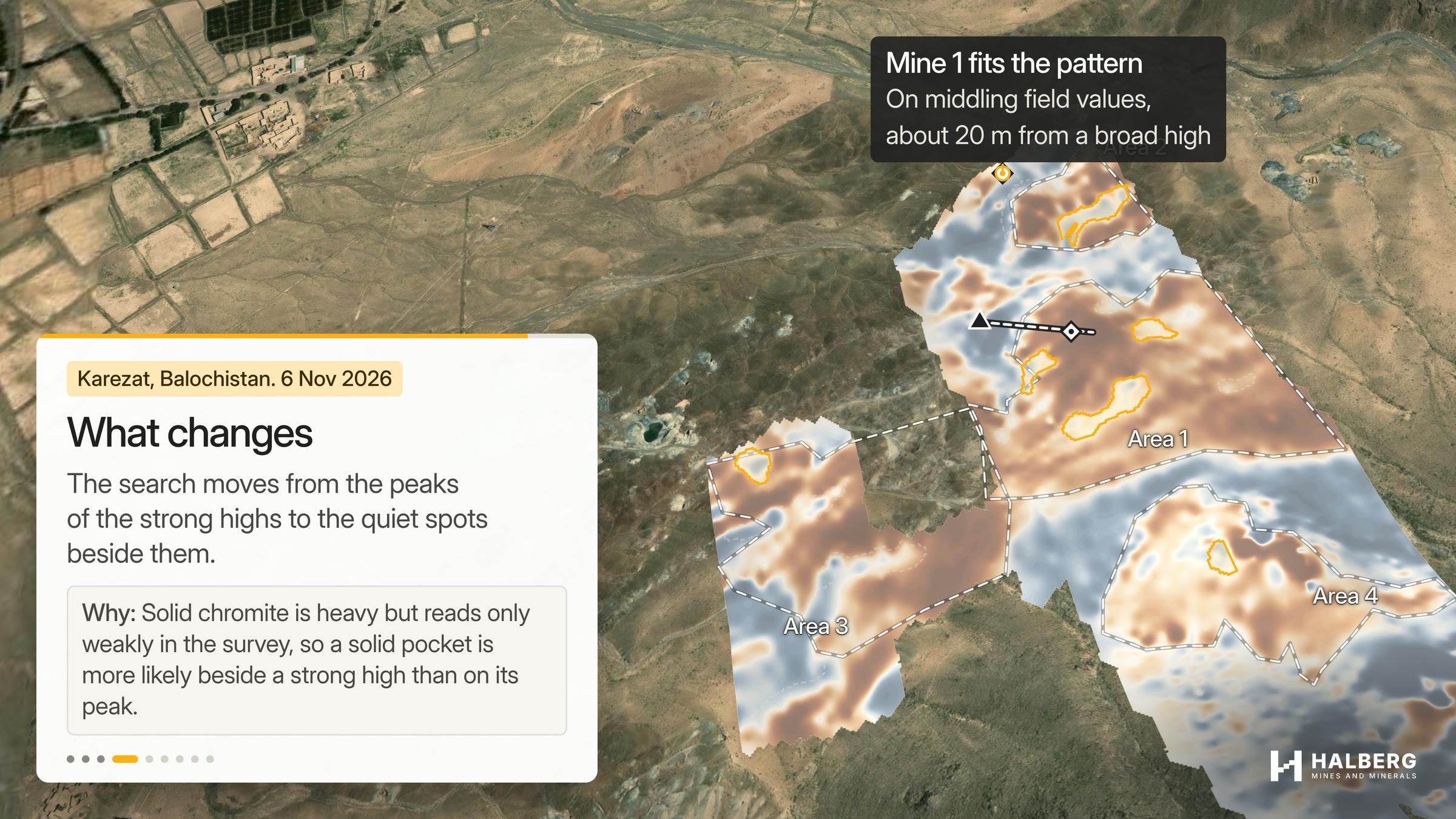
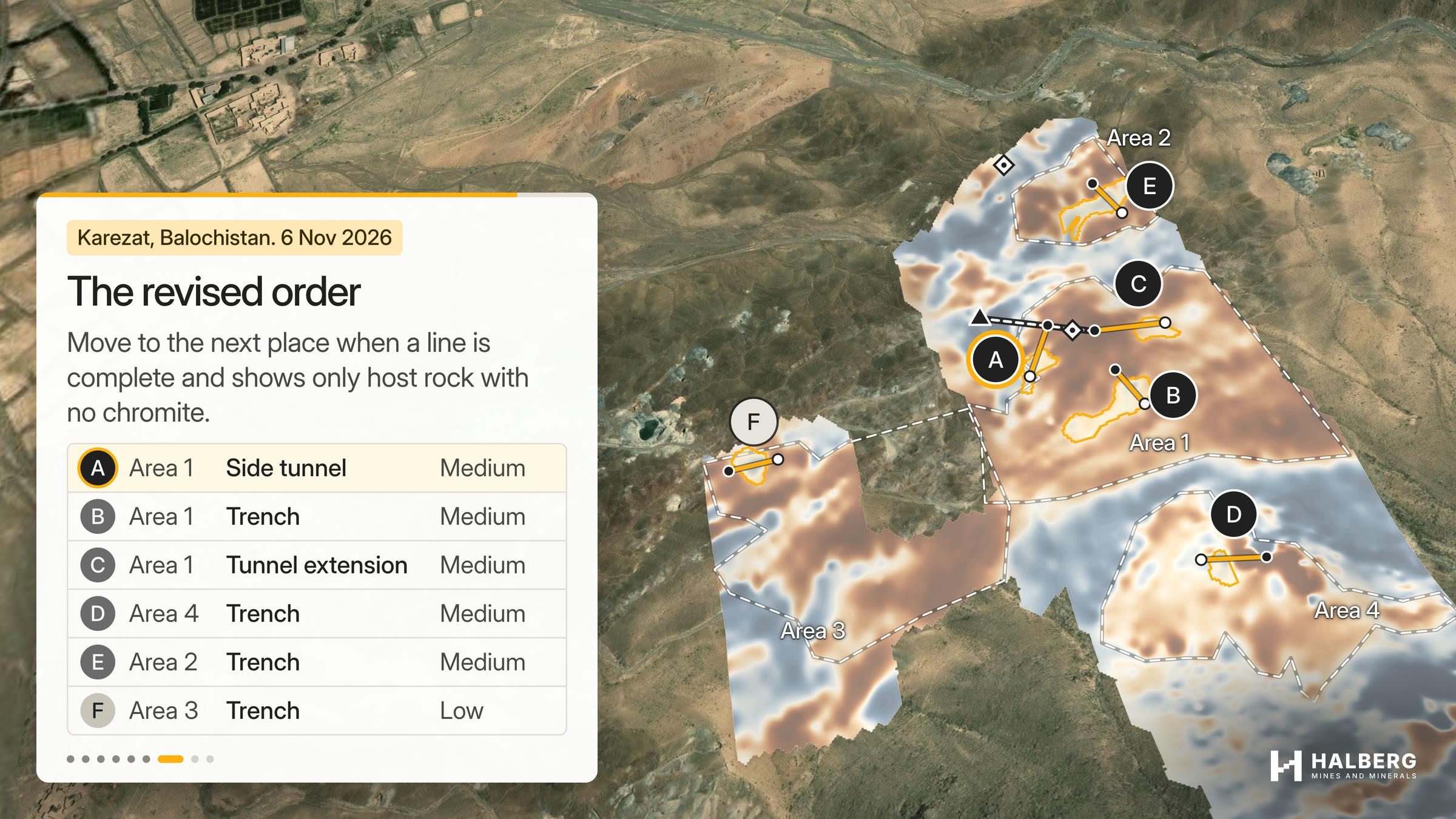
We examined 15 quiet spots enclosed by the host rock and put forward six places to test, in order:
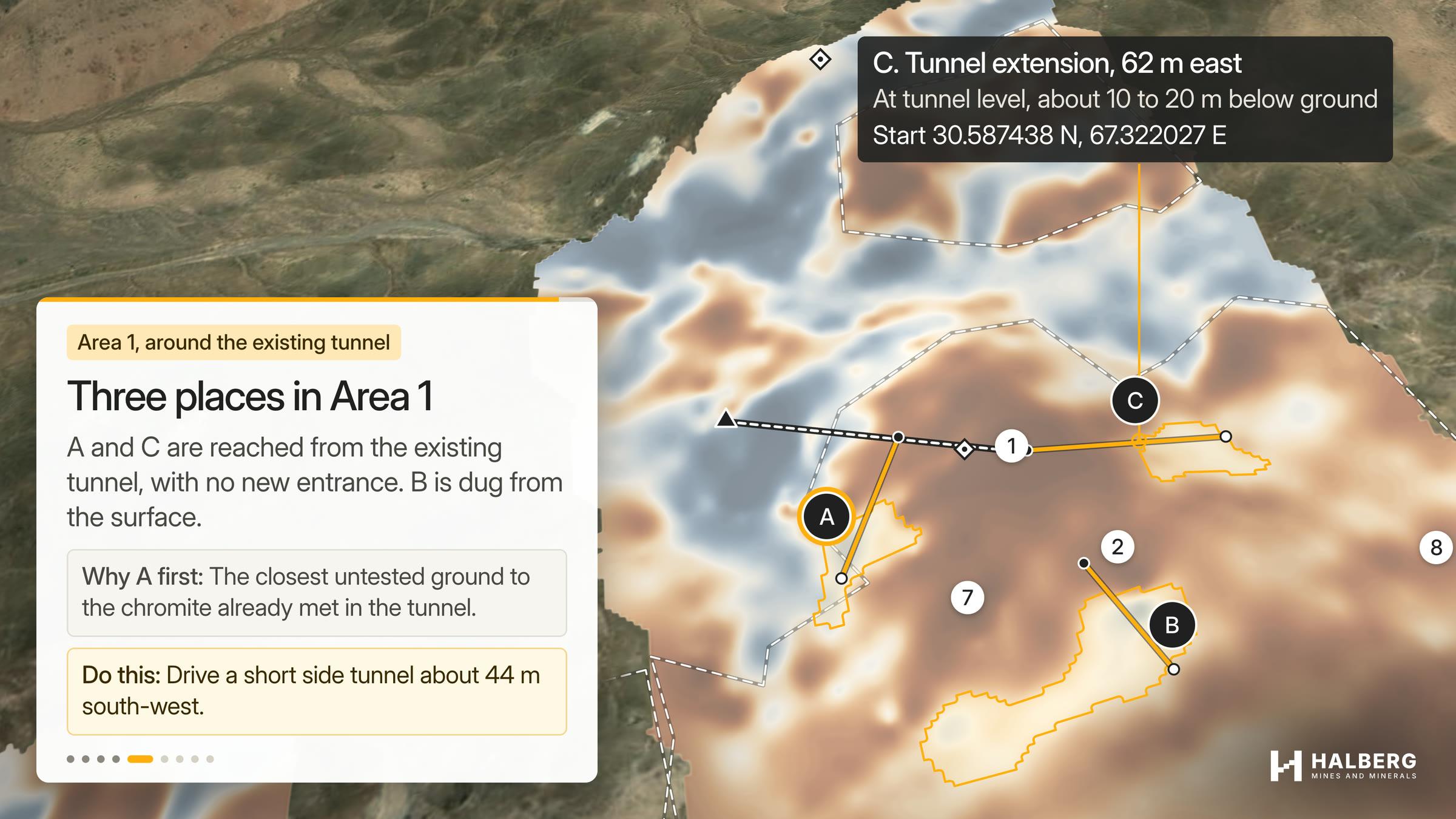
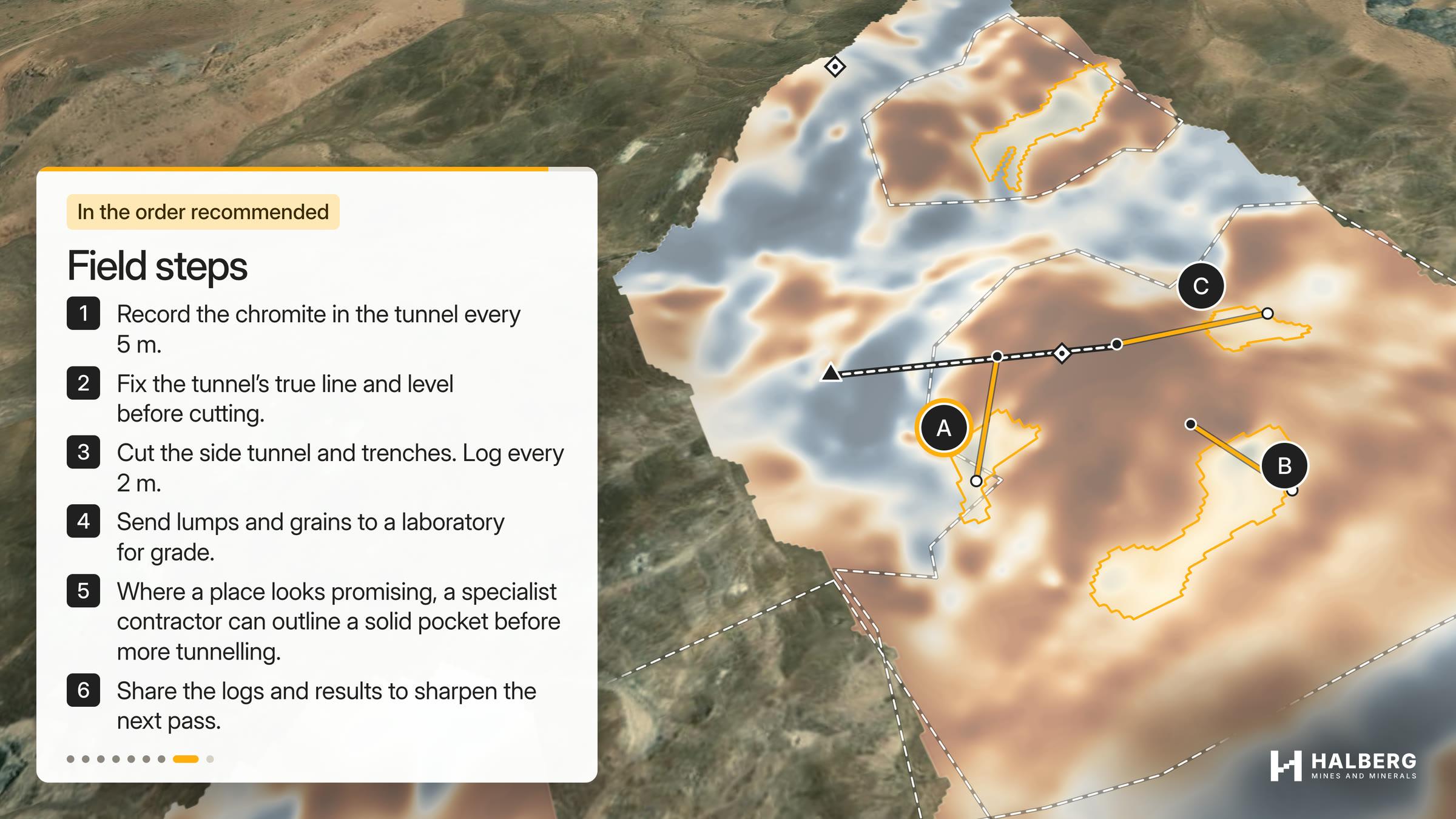
- Place A, Area 1. A side tunnel of about 44 metres, driven south-west from the existing tunnel. The closest untested ground to the chromite already met. Medium confidence.
- Place B, Area 1. A trench about 40 metres long, then a pit at its centre. The largest quiet spot in Area 1, enclosed by host rock on all sides. Medium confidence.
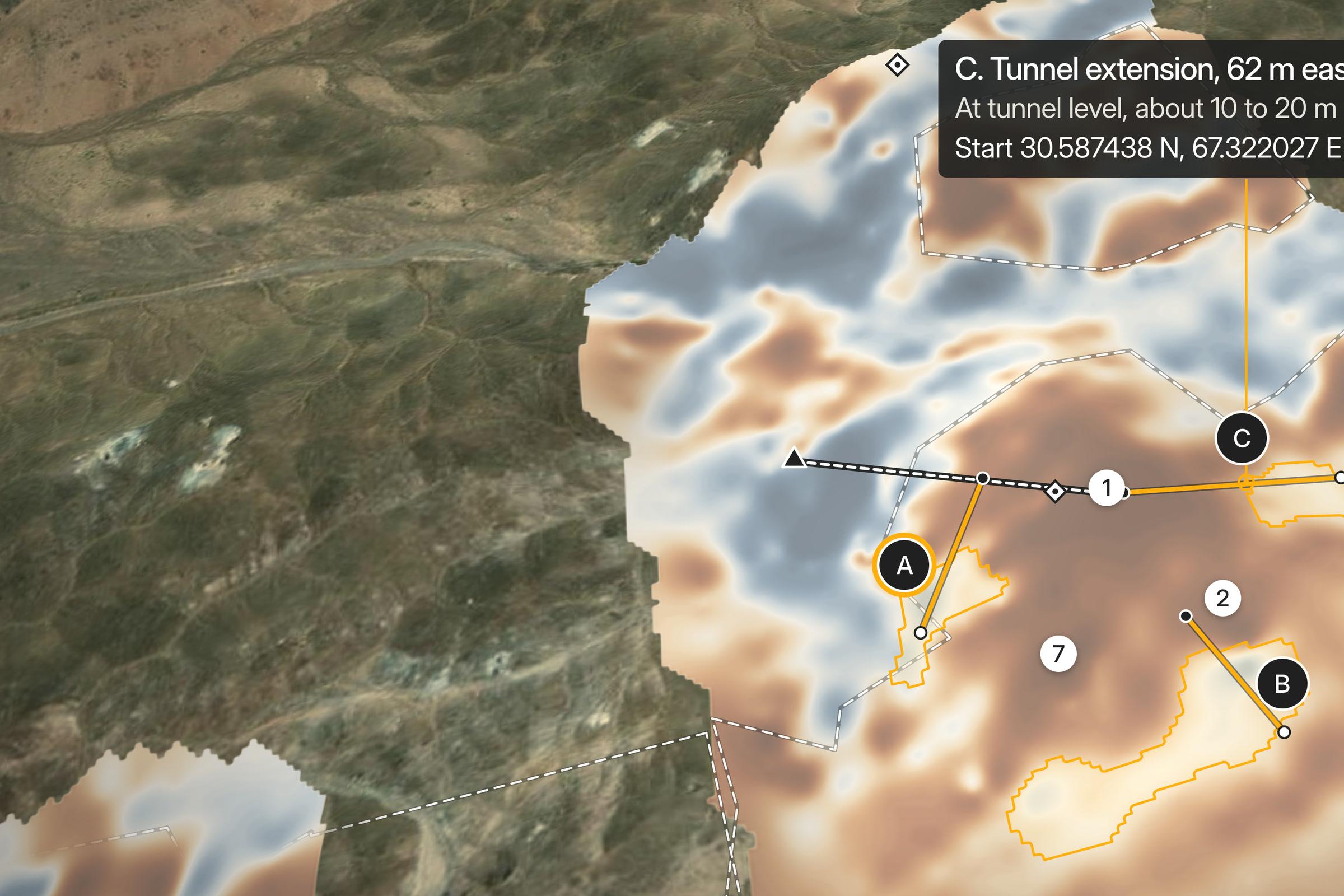
- Place C, Area 1. An extension of the existing tunnel about 62 metres to the east, beyond Target 1. Medium confidence.
- Place D, Area 4. A shallow trench of about 42 metres across new ground with no known working nearby. Medium confidence.
- Place E, Area 2. A trench of about 40 metres, with host rock from about 8 to 18 metres. Medium confidence.
- Place F, Area 3. A trench of about 40 metres. Low confidence.
A and C are reached from the existing tunnel, so they need no new entrance. For every place, the Second Pass report gives the exact line to cut, with start and end coordinates, the depth to expect and the reasons for its rank. It also sets out how each first-pass target now stands.
The field steps
The Second Pass report ends with six field steps, in the order recommended:
- Record the chromite in the existing tunnel every 5 metres: which wall, how many lumps, the size of the largest, and a photo with a tape or hammer for scale. Where lumps are most frequent is the best local guide.
- Confirm the tunnel's true line and level before cutting, since lines A and C start from it.
- Cut the side tunnel and the trenches, about 1 metre wide and down to fresh rock, and log each line every 2 metres.
- Send lumps and rock with grains to a laboratory as separate samples, for chromium oxide content and the chromium to iron ratio. These two figures decide which market the chromite suits.
- Where a place looks promising, a specialist contractor can outline a solid pocket before more tunnelling.
- Share the tunnel line, the logs, the photos and the laboratory results, so the next pass can be sharper again.
What the reports cannot do
The survey lines are about 20 metres apart, so features narrower than that are not fully resolved. A quiet spot can also come from a change in the rock, a fault or a gap between survey lines, so each place is a place to test, not a confirmed pocket. No survey shows the exact position or size of a chromite pocket. A trench, tunnel or drill hole and a laboratory result are needed.
These are targets for field checking. They are not resource or reserve estimates.
Why the order matters
A map does not prove a deposit. It narrows a large piece of ground to a few places worth digging, puts them in order and says how deep to go.
That matters because every decision after it costs real money: where to drive a tunnel, which trench to cut first, how many men and machines to commit, and for how long. A wrong guess can hold a crew for months and spend millions of rupees on ground that was never going to pay. A clear order of places to test puts that money where the odds are best. Each result from the ground then improves the next pass.
Mir Mines & Minerals shared their tunnel results quickly and in detail, and the second pass was built on them within a day. That is how this work should be done.
If you hold a lease and want the same for your ground, send the coordinates and what you know about it on WhatsApp to +92 342 514 7750, or through the contact page.